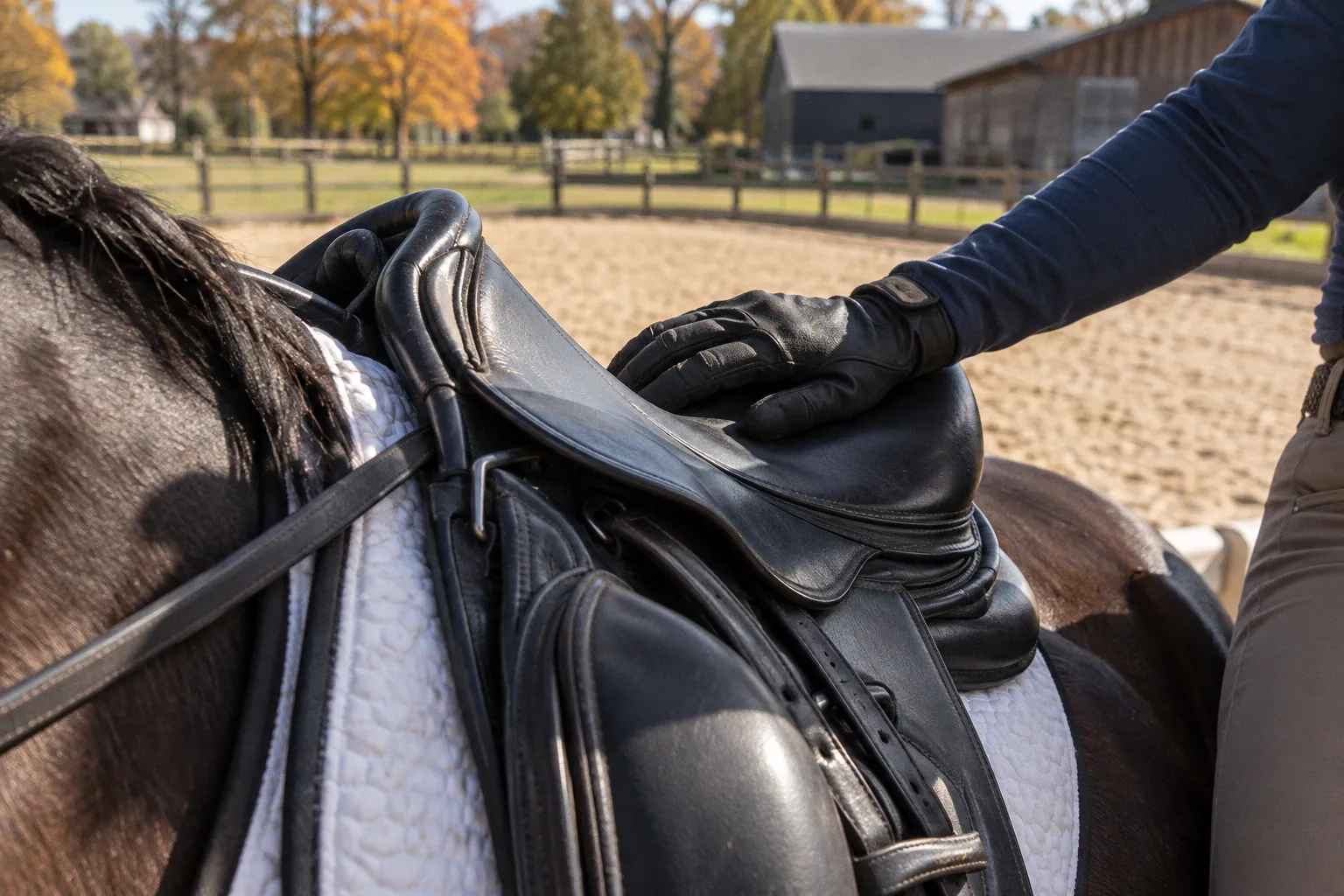
Your horse is not always the crooked one.
If you tip forward, grip with your thighs, brace your lower back, or collapse through one hip, the saddle is not receiving a neutral rider. It is receiving a moving problem. Your pelvis shifts, your seat bones lose equal contact, and your horse feels the change through the entire kinetic chain.
That is the uncomfortable part: many rider pelvic tilt causes in the saddle begin before you mount. Desk posture, shortened hip flexors, weak abdominal support, old asymmetries, and habitual bracing can all dictate how your pelvis behaves once the horse starts moving.
You cannot fix that by being told to sit up straight. You need to identify which way your pelvis is tilting, what is pulling it there, and whether your body can actually maintain alignment under motion.
A neutral pelvis is not a frozen pelvis
A balanced seat does not mean clamping your pelvis into one rigid position and hoping the horse moves underneath you.
Your pelvis has to absorb movement. It must respond to the horse’s back, the changing stride, transitions, lateral work, and your own shifts in balance. The target is not immobility. The target is controlled mobility.
Biomechanically, a neutral pelvis is commonly described by the relationship between the anterior superior iliac spines, or ASIS, at the front of the pelvis, and the posterior superior iliac spines, or PSIS, at the back. The alignment may be close to level or show a slight anterior angle of around 7–10 degrees.
That small anterior rotation matters. It allows the pelvis to sit over the seat bones without forcing the lumbar spine into an exaggerated arch or flattening its natural shock absorption.
Your spine has three normal curves:
- Cervical, through the neck
- Thoracic, through the upper and mid-back
- Lumbar, through the lower back
Good riding posture does not erase those curves. It stacks them. Your rib cage sits over your pelvis, your pelvis stays available beneath your torso, and your hips can move without your lower back taking over every job.
The quick alignment check
Stand in front of a mirror or ask someone to observe you from the side. Do not suck your stomach in. Do not perform a competition posture. Just stand as you normally do.
Look for these signs:
- Your belt line angles sharply downward toward the front.
- Your lower back looks heavily arched.
- Your ribs flare forward.
- Your knees drift behind your hips.
- Your weight sits toward the front of your feet.
- Your abdomen appears lengthened rather than supported.
- Your hip flexors feel tight when you try to extend the leg.
These are common signs associated with anterior pelvic tilt. They are not a diagnosis, and a mirror cannot tell you everything about dynamic movement. But they give you useful information before you start blaming the saddle, the horse, or your stirrup length.
A neutral pelvis is not a pose. It is a position you can control while the horse moves.
The saddle magnifies small errors. A slight pelvic rotation in halt may become a clear collapse in trot. A mild hip restriction may become thigh gripping, lumbar bracing, and uneven rein contact once the pace increases.
That is why a rider can feel aligned while standing still and completely lose the position in motion.
Desk life can arrive in the saddle with you
Sitting for long periods keeps the hips in flexion. Over time, the iliopsoas and related hip flexor group can become shortened and accustomed to holding the hip joint in that position.
Then you mount.
The hip remains partly flexed. The pelvis tips forward. The lumbar spine responds with more extension. You try to correct the problem by lifting your chest, which often sends the ribs forward and increases the brace through the lower back.
Now you are technically upright, but mechanically unstable.
This is one of the clearest impact pathways of tight hip flexors on riding posture. The body does not separate your office chair from your saddle. It brings the same restrictions to both.
Lower Crossed Syndrome and the rider’s brace
The pattern often described as Lower Crossed Syndrome involves a combination of tightness and weakness around the pelvis and lower spine.
In an anterior pelvic tilt pattern, the following muscles may become tight or shortened:
- Psoas
- Iliacus
- Rectus femoris
- Tensor fascia latae
- Erector spinae
At the same time, the rectus abdominis, external obliques, glutes, and hamstrings may become lengthened and underactive.
That combination creates a familiar riding problem: your hip flexors pull the pelvis forward while the muscles that should help control the position fail to provide enough support. You then recruit the lower back. Hard.
The result is not genuine core stability. It is bracing.
Bracing feels powerful because it creates instant stiffness. But a stiff rider cannot follow the horse cleanly. The pelvis stops absorbing movement, the hips lose freedom, and every stride travels up through the lumbar spine.
Do this:
- Exhale without collapsing your chest.
- Let the front ribs soften down.
- Feel the abdomen respond rather than suck inward.
- Keep the glutes available, not clenched.
- Allow the hip crease to lengthen as the leg drops.
Not this:
- Pull your stomach aggressively toward your spine.
- Tuck your tailbone under to fake a flat back.
- Push your chest up and forward.
- Grip with the knees to feel secure.
- Hold the breath through transitions.
Core engagement should help you manage your pelvic position. It should not turn your torso into a rigid block.
Anterior and posterior tilt create different riding problems
Not every misaligned pelvis tips forward. Some riders tuck under, flatten the lumbar curve, and sit behind the movement.
You need to know which pattern you are dealing with. Otherwise, you may apply the wrong correction and make the problem worse.
| Pelvic pattern | What may be happening physically | Common saddle effect |
|---|---|---|
| Anterior pelvic tilt | Hip flexors and erector spinae are tight; abdominals, glutes, and hamstrings may be lengthened and weak | Rider tips toward the pubic bone, increases lumbar lordosis, and loses hip suppleness |
| Posterior pelvic tilt | Hamstrings, abdominals, and glutes are tight; hip flexors and lower-back muscles may be weak and lengthened | Rider rounds the lower back, loses lumbar shock absorption, and may sit behind the horse |
| Dynamic asymmetry | One side rotates, collapses, or loads differently from the other | Uneven seat-bone contact, inconsistent rein connection, and difficulty maintaining straightness |
Anterior pelvic tilt: the forward spill
When the pelvis rotates forward, you may sit more on the pubic bone than on the seat bones. Your lower back increases its arch, and your hips may feel blocked rather than mobile.
Common equestrian anterior pelvic tilt symptoms include:
- A persistent feeling of falling toward the horse’s neck
- A lower back that aches after riding
- Difficulty keeping the leg long without gripping
- A thigh that feels tight at the front
- A tendency to brace during transitions
- A seat that becomes unstable when the horse lengthens the stride
- A habit of lifting the chest instead of organising the pelvis
The lazy correction is to tuck the pelvis aggressively. That may reduce the arch for a moment, but it often collapses the lumbar spine and restricts the horse-rider connection.
Your goal is not to flatten your back. Your goal is to bring the pelvis back under the rib cage while preserving the lumbar curve that lets you absorb movement.
Passive hamstring stretching alone will not solve this pattern. In anterior pelvic tilt, the hamstrings may already be held in a lengthened position. They may feel tight because they are working poorly, not because they simply need more stretching.
You need better control across the entire pelvic system: hip flexors, abdominal wall, glutes, lumbar spine, and breath.
Posterior pelvic tilt: the tucked-under seat
A posterior tilt sends the pelvis backward. The lumbar curve flattens, the tailbone tucks, and the rider may round through the shoulders.
This rider often believes they are sitting deeply. They may be sitting heavily, but heavy is not the same as stable.
The pelvis needs to remain responsive. When you tuck under, the lower back loses part of its natural shock absorption. The horse’s movement can then travel directly into the rider’s upper body, producing bouncing, stiffness, or a sense of being left behind.
Watch for:
- A rounded lower back
- Shoulders drifting behind the hips
- A tucked tailbone
- Hamstrings that dominate the seat
- Difficulty following the horse’s back
- A feeling that the leg cannot fall naturally from the hip
- Excessive effort to maintain contact during sitting trot
The correction is not to arch dramatically in the opposite direction. That simply trades one compensation for another.
Instead, find the middle: pelvis beneath the rib cage, seat bones available, lumbar curve present, and hip joint free enough to flex and extend as the horse moves.
The rider hip asymmetry problem
Pelvic tilt is rarely perfectly symmetrical. One side may rotate forward. One hip may sit higher. One seat bone may carry more weight. One knee may turn inward while the other leg drifts away.
That asymmetry changes the horse’s information.
Your horse does not experience your posture as an isolated visual detail. The animal feels pressure, timing, weight distribution, rein changes, and alterations in your movement. If your left side collapses in every corner, your left seat bone is not sending the same message as your right.
This is why rider hip asymmetry and saddle balance must be considered together. You may sit in a saddle that is correctly fitted and still load it unevenly through your own body.
Do not turn that into a blame game. The saddle may contribute. The horse may have its own movement pattern. But your pelvis remains part of the equation.
Your asymmetry meets the horse’s asymmetry
More than 90% of horses are reported to have a natural hollow side and a stiff side. That does not mean every crooked moment comes from the horse. It means you are working with a living body that already has preferences, restrictions, and patterns of loading.
Now add your own.
You may have a dominant leg, a history of injury, an old ankle restriction, a rotated pelvis, or a habit of collapsing through one side. The horse moves under that uneven load, adapts to it, and may appear more resistant on the side where your control is weakest.
This creates a feedback loop:
1. Your pelvis shifts toward one side.
2. Your seat bones apply uneven pressure.
3. Your leg and rein aids become asymmetrical.
4. The horse responds by stiffening or avoiding the contact.
5. You interpret the resistance as a horse problem.
6. You brace harder, increasing the original asymmetry.
That loop can become automatic. You do not need to consciously choose it.
How to tell whether your pelvis is driving the problem
Use simple movement observations rather than relying on how your position looks in a photograph.
Ask yourself:
- Do you lose one stirrup more often?
- Does one hip feel jammed during a turn?
- Does one knee grip when the horse becomes tense?
- Does one shoulder move forward every time you sit the trot?
- Do you consistently drift toward the same side?
- Does your lower back ache more on one side?
- Does your horse become more resistant when you try to sit taller?
- Can you breathe evenly into both sides of your rib cage?
These questions do not identify a medical condition. They reveal repeatable movement behaviour.
A useful riding cue is to imagine both seat bones widening downward without forcing them into the saddle. Then check whether one side disappears when the horse changes pace.
If the left seat bone vanishes in trot, do not shove the left hip down. That usually creates more tension. Reduce the brace, soften the exhale, and notice whether the rib cage is collapsing above that hip.
The pelvis rarely acts alone. Your ribs, breathing pattern, jaw, shoulders, and feet all influence the kinetic chain.
Stop trying to pin your pelvis down. Teach it to stay organised while everything else moves.
Somatic work gives you access to the restriction
Biomechanics explains the position. Somatic work helps you notice how you create it.
That distinction matters. You can understand that your pelvis is in anterior tilt and still repeat the same pattern because your nervous system treats the brace as normal. The restriction may not feel like a restriction. It may feel like security.
Rider shiatsu therapy and other forms of equestrian somatic bodywork can be used to improve body awareness around the hips, lumbar region, sacrum, abdomen, and legs. The point is not to force the pelvis into alignment through pressure. The point is to help you recognise tone, asymmetry, and changes in movement quality.
A skilled practitioner may work with areas that influence the rider’s sense of grounding and mobility, while you actively notice:
- Where you hold unnecessary tension
- Whether one hip feels more compressed
- How your breathing changes when the pelvis moves
- Whether the abdomen can support without gripping
- Whether the legs can lengthen without being pushed down
- How your weight shifts between the two seat bones
This is not passive maintenance. You still have to use the information in the saddle.
Three off-horse drills to start reclaiming pelvic control
1. The hip-flexor reset
Kneel in a half-lunge with one foot forward. Keep the front ribs stacked over the pelvis. Do not arch the lower back to create the sensation of a stretch.
Gently lengthen the hip of the kneeling leg by moving the pelvis forward a small amount while keeping the glute lightly active. Hold a position where you can breathe normally.
If your lower back takes over, you have gone too far.
The aim is not maximum intensity. It is to teach the hip flexor group that the hip can extend without the lumbar spine compensating.
2. The pelvic clock
Lie on your back with your knees bent and feet supported. Imagine your pelvis as the face of a clock.
Slowly explore:
- Tipping the pelvis slightly toward 12 o’clock
- Moving toward 6 o’clock
- Shifting gently toward 3 o’clock
- Shifting toward 9 o’clock
Keep the movement small. Do not force a stretch. Notice whether one direction feels unavailable or whether one side recruits the ribs and shoulders.
This improves your map of the pelvis. You cannot control a position you cannot sense.
3. The seat-bone balance test
Sit on a firm chair with your feet grounded. Find the two bony points beneath the pelvis. Let your torso stack over them without stiffening.
Shift a little more weight onto one side, then the other. Return to centre.
Now breathe out and allow the ribs to soften. Check whether the pelvis moves, or whether you immediately brace the abdomen and shoulders.
This is the off-horse version of your saddle problem. If you cannot move your weight without gripping, expect the same strategy to appear in trot.
Do this in the saddle
Start in walk. The walk gives you time to observe instead of react.
- Feel both seat bones without pressing them down.
- Let the thighs rotate from the hip rather than forcing the knees inward.
- Keep the front ribs quiet.
- Exhale through the transition instead of holding your breath.
- Allow the pelvis to follow the horse’s back.
- Notice whether one hip moves less than the other.
- Return to neutral before adding speed or complexity.
Then test the position during short periods of sitting trot. Not an entire training session. A few strides. Reset. Repeat.
More time in a poor position will not teach your body a better one. It will simply make the compensation more familiar.
Alignment is a riding skill, not a cosmetic adjustment
The best posture correction is the one that survives movement.
If your pelvis looks square only while you hold your breath, it is not square in any useful riding sense. If your core feels engaged only when your back becomes rigid, it is not supporting the horse-rider connection. If your hips align in halt but collapse through every transition, you have not yet built control under load.
That is where the real work sits.
Address the tight hip flexors. Build abdominal and glute support without clenching. Restore pelvic mobility. Notice your asymmetry before it reaches the reins. Use hands-on bodywork as a way to improve awareness, not as a replacement for active training.
And stop blaming the horse for every crooked moment.
Your horse may have a stiff side. Your saddle may need assessment. Your own body still has to show up organised, mobile, and honest.
Before your next ride, spend five minutes on the floor: one controlled half-lunge on each side, a gentle pelvic clock, and a seated breath check. Then mount and test your seat in walk before asking for more.
Small correction. Clear feedback. No drama.
That is how you build a pelvis that can follow the horse instead of fighting it.