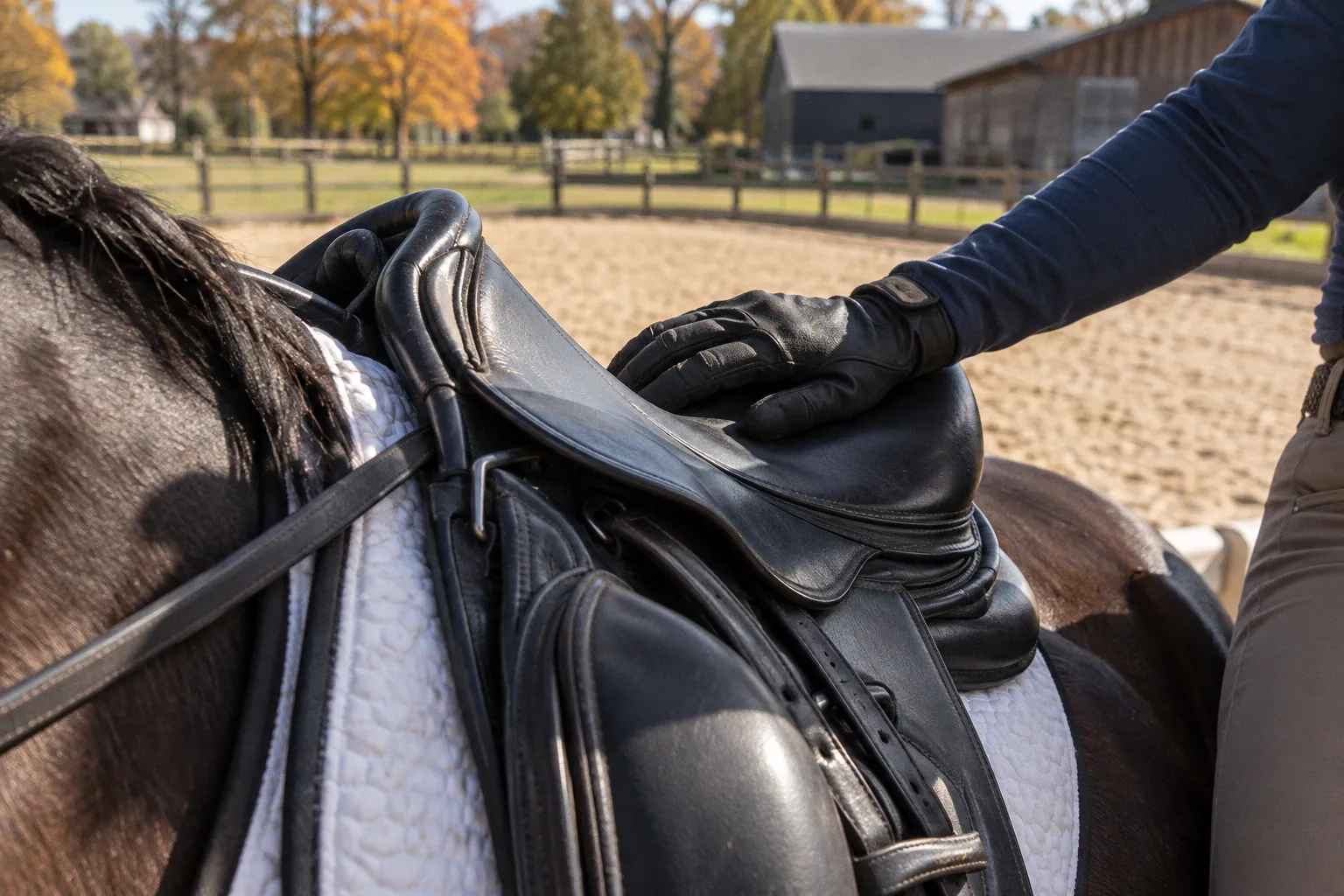
One shoulder sits higher. One rein feels shorter. One seat bone disappears, while the other lands heavily enough to make the saddle feel crooked.
That is rider shoulder asymmetry in action. And no, the problem usually does not begin in your shoulder.
The visible collapse often starts lower in the kinetic chain: a pelvic tilt, uneven seat-bone pressure, a leg-length discrepancy, or the horse’s own natural lateral asymmetry. Your spine then twists to keep your head centred. The shoulder shifts. The hand compensates. The rein contact changes. The horse responds to the entire chain, not just the part you can see in the mirror.
This is why endless shoulder rolls rarely solve uneven rein contact. You are trying to correct the final link while ignoring the first one.
The kinetic chain: why pelvic tilt dictates shoulder position
Your shoulders do not float independently above the saddle. They stack on your rib cage, which stacks on your pelvis, which is influenced by your hips, legs, feet and the horse beneath you.
If one side of your pelvis lifts or rotates, your spine has to adapt. It may bend slightly, twist, or shift sideways so your head stays more or less upright. You can look straight ahead while your body is anything but symmetrical.
That compensation can create several familiar riding problems:
- One shoulder rises toward your ear while the opposite side drops.
- One shoulder blade feels tight or sits further back.
- One elbow locks against your side while the other floats away.
- One rein becomes stronger, shorter or more active.
- You feel as though you are sitting to one side, even when the saddle is centred.
- Your horse bends more easily in one direction and braces through the opposite rein.
The rider posture imbalance symptoms are often subtle at first. You may not feel dramatically crooked. You may simply notice that one arm works harder, one stirrup feels longer, or one hip loses contact in canter.
Then the body repeats the pattern hundreds of times during a ride. That is how a small alignment fault becomes a stable movement strategy.
The standing test
Before blaming your saddle, horse or hands, stand in front of a mirror.
Do not pose. Do not pull your shoulders back. Stand as you normally stand after a long day.
Check:
- Are both collarbones roughly level?
- Does one shoulder sit closer to your ear?
- Is one arm hanging further away from your body?
- Do your trouser seams rotate differently from side to side?
- Does one foot turn out more?
- Is your head centred over your sternum, or does it drift slightly?
- Does one knee lock while the other remains soft?
Now place two fingers on the front points of your pelvis. Are they level? Do they face in the same direction? If one side sits higher or rotates forward, do not expect the shoulders to remain perfectly horizontal in the saddle.
This is not a diagnosis. It is a starting point. Structural differences, functional habits and pain can create similar visual patterns. A qualified clinician or physiotherapist needs to assess persistent asymmetry, especially if it comes with numbness, weakness or sharp pain.
If your pelvis is tilted, your shoulder is not the original problem. It is the body’s late-stage attempt to keep you upright.
Functional scoliosis and the hidden cost of uneven seat bones
The word scoliosis can make riders panic. Functional scoliosis is not the same thing as a fixed structural spinal curve. In this context, it describes a temporary or movement-related spinal deviation created by asymmetrical loading, muscle tension or pelvic positioning.
You sit more heavily on one seat bone. Your trunk shifts to keep your eyes level. Your spine rotates. One shoulder appears further back. The pattern may reduce when you lie down, change stance or unload the pelvis.
That does not make it irrelevant. The horse feels the movement pattern you bring into the saddle, not the label attached to it.
A rider who sits toward the right often does so because the right seat bone is higher or the left side is carrying more weight. The spine subtly twists to preserve head position. The right shoulder may then sit further back, while the left side collapses or reaches.
The exact direction varies. Bodies are not diagrams. You cannot diagnose the whole chain from a single photograph.
What you can do is track the relationship between the parts.
Uneven seat bones create uneven rein contact
When one seat bone carries more load, your hips do not move evenly with the horse. One side may brace. The opposite side may become passive. Your torso then rotates to stabilise the pelvis.
Your hands inherit that rotation.
This is where riders often make the wrong correction. They shorten the longer rein. They force the wandering shoulder back. They pull the elbow into the waist. The body resists, and the horse receives a more confusing signal.
Try this instead:
1. Halt on a straight line and allow both reins to have the same length.
2. Feel both seat bones without forcing them down.
3. Notice whether one knee grips more tightly.
4. Let your breath expand into the lower ribs on the compressed side.
5. Check whether your shoulders become more level when your pelvis softens.
6. Walk forward and keep the correction small enough that you can breathe.
Do not shove your heavy seat bone down. That creates more bracing. You want distributed contact, not a rider stamped into place.
Leg length discrepancy: real, functional or both?
A difference in leg length can influence rider shoulder asymmetry causes in the saddle. Research by Symes and Ellis in 2009 reported a relationship between asymmetry in shoulder rotation during riding and leg-length discrepancy measured while standing.
That does not mean every crooked shoulder comes from a genuinely shorter leg. The difference may be:
- Structural, involving bone length.
- Functional, created by pelvic rotation or hip positioning.
- Apparent, caused by stirrup length, saddle balance or the horse’s movement.
- A combination of several factors.
Do not immediately add a shim, alter your stirrup length or stretch one side aggressively because a photograph looks uneven. First establish what changes when you alter the pelvis, the foot position and the saddle setup.
A saddle that sits off-centre can amplify a rider’s existing asymmetry. But a symmetrical saddle cannot automatically repair a rider who consistently loads one seat bone or braces one hip. The horse’s asymmetry can also pull the saddle and rider into a familiar pattern.
This is a system. Treat it like one.
Mirroring tension: how rider imbalance impacts equine gait
Your horse does not experience your shoulder tension as an isolated rider problem. Muscle stiffness in your throat, shoulder or upper back can create mirror tension in the corresponding upper-body muscles of the horse and affect the poll connection.
That is why a tight right shoulder may coincide with a horse that braces through the right side of the neck. You tighten. The horse shortens. You feel resistance and add more hand. The horse protects the same side more strongly.
Now you have a feedback loop.
Pressure mapping and motion-capture research show that rider asymmetry can alter equine gait, spinal movement and rein tension. Your imbalance can change how the horse distributes movement through the back. The horse then changes how it carries you. You interpret that altered motion as proof that the horse is the crooked one.
Sometimes the horse is asymmetrical too. More than 150,000 horses have been evaluated in studies observing natural lateral differences in shoulder and muscle development. Horses have preferred movement patterns, stronger and weaker sides, and habitual ways of stabilising the trunk.
That is not an excuse to blame the horse. It is a reason to stop treating the rider and horse as separate mechanical units.
The shoulder-to-poll connection
Watch what happens when you clench your jaw or lift your shoulder toward your ear. Your breathing changes. Your arm becomes less independent. The rein follows the tension upward.
Your horse may respond by:
- Shortening the neck on that side.
- Hollowing or bracing through the base of the neck.
- Losing rhythm in one rein.
- Falling through a shoulder.
- Struggling to maintain consistent bend.
- Carrying the head unevenly.
The answer is not to throw away the contact and hope the horse sorts itself out. The answer is to restore a cleaner connection through your own trunk.
Use a simple walk test:
- Ride on a long side with a soft, even contact.
- Notice which hand feels heavier.
- Soften both elbows without widening your hands.
- Let the back of your neck lengthen.
- Feel whether your sternum points straight ahead.
- Compare the horse’s stride before and after your shoulder releases.
If the horse improves when you reduce your own bracing, you have useful information. You do not need to invent a dramatic theory. Your body just gave you feedback.
Biomechanical benchmarks for achieving horizontal alignment
Perfect symmetry is not the goal. Living bodies are not manufactured to identical specifications. The goal is functional symmetry: enough evenness that both sides can absorb movement, follow the horse and communicate without unnecessary force.
Start with the basic horizontal benchmarks. Your shoulders and knees should be able to organise around a stable, adaptable pelvis rather than collapse toward the same side.
What to monitor in the saddle
Use these benchmarks during transitions, circles and straight lines:
- Shoulders: roughly level, without one side hiking or rolling forward.
- Sternum: directed along the line of travel rather than rotated toward the stronger rein.
- Elbows: hanging under the shoulders, able to move with the horse’s neck.
- Seat bones: present on both sides without one side driving or pressing constantly.
- Knees: pointing down and forward without one knee gripping for security.
- Lower legs: connected but not clamped, with the feet supported by the stirrups.
- Head: centred over the trunk, not used as a counterweight.
- Reins: similar length and elasticity, unless the exercise deliberately requires otherwise.
Do not stare at every body part at once. Pick one reference point, then feel the whole chain.
Do this / Not this
| Problem you notice | Do this | Not this |
|---|---|---|
| Right shoulder keeps lifting | Exhale into the right lower ribs and soften the right elbow | Force the shoulder down and lock the arm |
| Left seat bone disappears | Reduce the opposite-side brace and let the left hip move with the stride | Slam the left seat bone into the saddle |
| One rein feels permanently shorter | Check pelvis rotation, elbow position and saddle balance | Keep shortening the longer-feeling rein |
| Horse falls through one shoulder | Re-centre your sternum and organise your outside leg | Pull the horse’s head back to the middle |
| One stirrup feels too long | Test pelvic position and hip mobility before changing equipment | Alter stirrup length repeatedly without assessment |
| Shoulder blade tension returns after a few minutes | Reset the trunk and breathing during movement | Stretch once before riding and ignore it for an hour |
That final point matters. A posture correction that only works while you hold your breath is not a correction. It is a brace.
Use the horizontal shoulder-knee line
A useful visual benchmark is the relationship between the rider’s shoulders and knees. They do not need to form a rigid straight line, but they should remain horizontally organised as the horse moves beneath you.
Film yourself from behind and from the side during walk and rising trot. Do not judge only the still frame at halt. Many riders appear symmetrical when stationary and collapse as soon as the horse adds movement.
Watch for:
- One shoulder dropping at every sitting phase.
- One hip sliding forward during rising trot.
- The torso rotating when the horse bends.
- One knee lifting as the rider posts.
- The head staying still while the shoulders and pelvis swing underneath it.
That last pattern is especially revealing. You may think you are balanced because your head remains centred. In reality, your spine may be working overtime to hide the shift.
Somatic bodywork: where shiatsu fits
Rider shiatsu therapy and equestrian somatic bodywork can help you notice where you brace, where movement stops and where one side refuses to lengthen. The value is not a magical reset. It is improved sensory information and more available movement.
If your hip flexors, adductors, thoracic muscles or neck are guarding, your nervous system may treat a neutral riding position as unsafe or unfamiliar. You then return to the old pattern as soon as the horse moves.
Hands-on work can support change by reducing unnecessary tone and improving your ability to feel the pelvis, ribs and shoulder girdle. But bodywork should lead into movement practice. If you leave a session feeling loose and then ride exactly as before, the old asymmetry will usually reclaim the space.
A useful session should connect sensation to action:
1. Identify the side that feels compressed or overactive.
2. Work through the surrounding tissues without forcing pain.
3. Recheck breathing and pelvic movement.
4. Stand and compare both sides.
5. Repeat a simple riding movement, such as walk on a long rein.
6. Apply one clear cue rather than ten corrections.
The cue might be: “both sit bones,” “soft right elbow,” or “sternum over the midline.” Short cues work because you can use them while riding. A lecture about every vertebra will not survive the first transition.
A practical off-horse sequence
Use this before riding or on a non-riding day. Move slowly enough to feel the difference between mobility and compensation.
1. Pelvic clock
Lie on your back with your knees bent and feet on the floor. Gently tilt the pelvis forward and back, then shift the weight slightly from one side to the other.
Do not flatten your back aggressively. You are mapping movement, not winning a battle against the floor.
2. Rib-to-pelvis breathing
Place one hand on the lower ribs and one on the front of the pelvis. Breathe into the side that feels compressed. Keep the shoulders quiet.
If the breath only reaches the upper chest, reduce the effort. Your goal is expansion, not a larger inhale.
3. Thoracic rotation
Stay on your side with the hips and knees comfortably bent. Rotate the upper arm across the body and open it without dragging the pelvis with you.
Notice whether one direction feels blocked. Do not force the restricted side into a bigger range. Let the ribs move while the pelvis stays organised.
4. Single-leg balance
Stand near support. Lift one foot and observe what happens to your pelvis, ribs and shoulder. Does the trunk shift immediately? Does one hip grip? Does the standing knee lock?
This exposes the control problem that often appears in the stirrups.
5. Wall alignment reset
Stand with your back near a wall, not pinned flat against it. Feel the back of your head, ribs and pelvis without forcing all three into contact.
Then step away and keep the same stacked feeling while breathing normally. If you lose it instantly, you are holding a position rather than owning an alignment.
None of these exercises replaces assessment for persistent pain. Rider back pain relief requires more than posture slogans when the pain is sharp, radiating or worsening. Get the right professional involved rather than trying to out-stubborn an injured body.
Stop making the horse pay for your asymmetry
A crooked rider can make a sound horse look resistant. A crooked horse can make a balanced rider feel unstable. Most real examples contain a conversation between the two.
That conversation becomes easier to read when you separate the variables.
Ride briefly on a straight line. Then ride a large circle in each direction. Compare the quality of your own body:
- Which direction lets both elbows stay elastic?
- Which direction makes one shoulder retreat?
- Which rein creates more throat or jaw tension?
- Does your pelvis shift when you change the bend?
- Does the horse become straighter when you soften, or only when you increase the rein?
If one direction feels difficult, do not immediately drill that side for twenty minutes. Repetition can strengthen the compensation. Alternate short efforts with a neutral walk and reassess.
The horse needs a rider who can absorb movement, not a rider who can maintain a perfect pose for three strides.
Symmetry is not holding yourself still. It is keeping both sides available while the horse moves.
A better plan for improving rider symmetry through bodywork
Treat your asymmetry as a pattern to investigate, not a flaw to punish.
Start with a simple weekly structure:
- Before riding: two minutes of pelvic and rib awareness, followed by a quiet walk.
- During riding: choose one alignment cue and check it during transitions.
- After riding: note which side tightened first and what exercise exposed it.
- On non-riding days: work on hip mobility, thoracic rotation, breathing and single-leg control.
- With bodywork: use rider shiatsu or manual therapy to improve awareness and movement options, then apply the change in an active task.
- With equipment: assess saddle balance, stirrup length and rein setup without assuming equipment is the whole answer.
Keep the notes factual. “Right shoulder tight after left canter, left seat bone lost during rising trot” tells you more than “felt crooked.”
If your shoulder asymmetry changes dramatically with pain, fatigue or a particular saddle, record that too. The pattern may be functional and modifiable. It may also need a clinical assessment.
Do not chase visual perfection. Chase better options.
You want to be able to sit without collapsing, take contact without gripping, and follow the horse without twisting through the spine to keep your head level. That takes pelvic control, mobile hips, responsive ribs and enough core stability to organise the trunk without bracing it rigid.
The next time one shoulder feels tighter, do not yank it down. Stop and ask where the shift began. Check the seat bones. Check the pelvis. Check the leg. Check the horse’s line of travel.
Then make one physical change you can breathe through.
That is how rider symmetry improves: not through force, not through blame, and not through pretending the shoulder is the whole problem.