Why Your Physical Asymmetry Is a Hidden Welfare Risk for Your Horse
Eurodressage reports that equitation science specialist Dr.
Victoria Lewis has highlighted chronic lower-back and hip pain among dressage riders as a welfare issue—not merely a rider-comfort problem. The findings point to widespread pain, poor functional movement and asymmetry, alongside limited use of physical therapy and heavy reliance on pain medication. For your horse, that matters. Your body is part of the kinetic chain.
Your asymmetry does not stay with you
Dressage riders are trained to inspect everything: the horse’s symmetry, muscle tone, balance, movement and soundness. But turn that scrutiny back on yourself. Are you sitting evenly? Can you maintain core stability without bracing one side harder than the other? Does your pelvis drift, collapse or tilt when the work gets difficult?
These are not cosmetic details. Lewis’s findings highlight a direct relationship between rider asymmetry and equine welfare and performance. If your position changes because your back or hip hurts, the horse receives a different set of signals through the saddle, seat and reins. The partnership has to compensate somewhere.
That does not mean every uneven step comes from the rider. It does mean you cannot automatically blame the horse.
Pain can narrow your movement. It can make you protect one hip, shorten one side of the body or avoid rotation. The result may look like a training problem, a resistance issue or a horse that suddenly feels “crooked.” Sometimes the rider needs to be part of the investigation.
Stop treating pain as proof of commitment
The report describes a significant gap between riders experiencing pain and riders using physical therapy to address it. Pain medication also featured heavily in the findings. That is a familiar trap in high-performance sport: manage the symptom, mount up, repeat.
But pain is not a badge of honour. It is information.
The practical question is not whether you can finish the lesson. You probably can. The better question is whether your movement quality deteriorates while you do it.
Use a blunt self-check before riding:
- Can you stand evenly without shifting away from one hip?
- Can you hinge, squat and rotate without obvious compensation?
- Does one side fatigue first when you brace your trunk?
- Does your riding position change once the pace, collection or concentration increases?
- Are you managing pain, or merely overriding it?
Do not turn this into a home diagnosis. The point is to identify a pattern worth discussing with an appropriately qualified professional. If pain repeatedly alters your alignment, pretending it is normal will not improve your horse’s experience—or your own.
Build the rider into the welfare plan
The most important shift is simple: assess the rider with the same seriousness given to the horse.
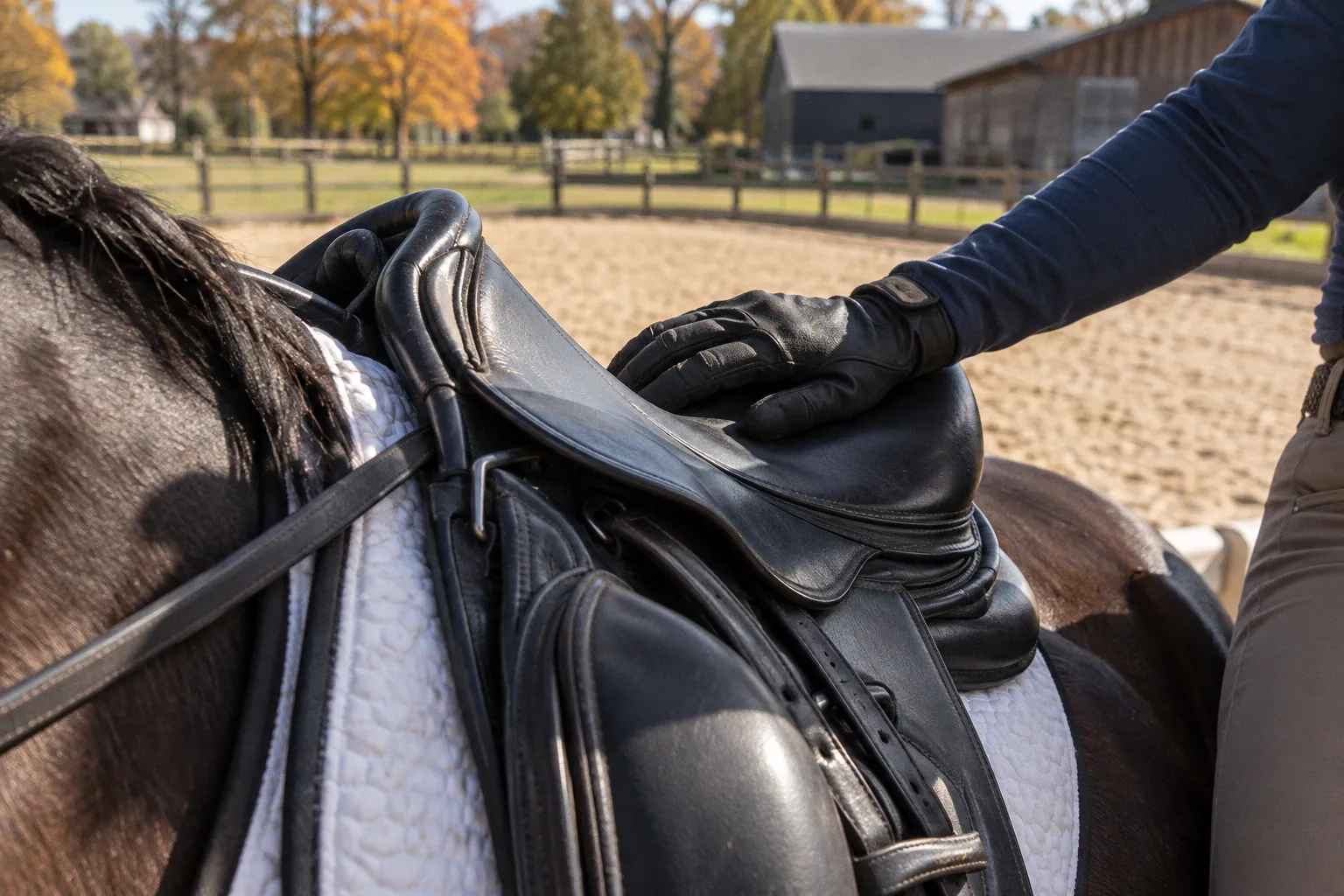
A horse may receive regular attention to soundness, muscle tone, nutrition and movement. The rider often gets a saddle check, a few stretches and a command to “relax.” That is not enough. Relaxation without control is collapse. Control without mobility is bracing. Neither creates a stable, adaptable seat.
Lewis’s presentation puts rider preparation inside the welfare conversation. Functional movement, symmetry and pain management belong in the training plan, not in the category of personal inconveniences to hide until competition day.
Start with observation. Ask your instructor or therapist to watch what happens when you are tired, not just when you look polished for the first ten minutes. Track where discomfort appears and whether it coincides with a change in pelvic position, trunk stability or rein contact. Then act on the pattern instead of masking it.
Your horse cannot correct a rider who refuses to examine their own mechanics. Check your body before demanding better movement from the horse.